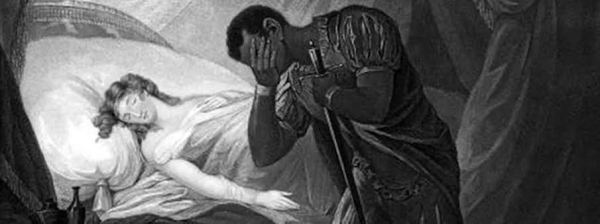

When it comes to tragedies, the first name that comes to most minds would be Shakespeare. Through his dramas, he has analyzed and influenced this genre probably more than any writer ever. So the question of who is the most tragic character ever in art cannot be answered without taking his works into consideration. And of course, the answer to that question would be subjective, changing from people to people, but I found my answer in the character of Desdemona, from William Shakespeare’s Othello. And I am trying to explain this using two brilliant Indian movie adaptations of the play: Vishal Bharadwaj’s Omkara (Hindi, 2006) and Jayaraj’s Kaliyattam (Malayalam, 1997).
(Oh, and SPOILER ALERT for anyone not familiar with the plot of Othello).
Look at the way how both these filmmakers depicted the scene of Othello killing Desdemona.
In Omkara, Ajay Devgan’s Othello/Omkara directly starts the scene by giving Kareena Kapoor’s Dolly/Desdemona the news of Vivek Oberoi’s Kesu/Cassio’s death and also showing her the Kamarbandh (A handkerchief in the original, Othello‘s first gift to Desdemona), which he found in the hands of Kesu. There are no cryptic remarks or any masked threats in Omkara‘s words, which gels well with his character of a tough guy in a life of crime. He straight out says what’s in his mind, accusing Dolly of sleeping with Kesu, and asking her to admit that fact, and that he will spare her life if she does so. But despite her tears, what comes across Dolly‘s face is a laugh, as she tells him she has heard enough, enough for a lifetime, and as she hugs him, he suffocates her with a pillow.

While Vishal Bharadwaj went with this more direct approach, Jayaraj’s Kaliyattam stayed more true to the original text of Shakespeare. As Suresh Gopi’s Kannan Perumalayan/Othello approaches a sleeping Thamara/Desdemona (Manju Warrier), he goes into a monologue, in a literal translation of Shakespeare’s description of her beauty, and how he was gonna kill her, but not hurt that beauty. As she wakes up when he kisses her, he turns away from her and asks her to pray, as she is about to be killed. He tells her he found the Saree he gave her in the hands of Kanthan/Cassio (Biju Menon) and the fact that he’s dead. Like in the original version, Kannan does not allow her to understand what the situation is, neither does he allow her to explain herself. She begs for another day so she can prove herself, but he suffocates her right there.

So, what makes this character the most tragic? The answer is perplexity, which was not explored enough in Omkara, however brilliant that adaptation was. The character of Desdemona/Dolly/Thamara is not sure what her fault is. In the original text, she even says the words: “When your eyes roll so: why I should fear I know not, Since guiltiness, I know not.” She has done nothing wrong, and that makes Othello‘s anger towards her confusing for her. She loves him so much so that, she would gladly die in his arms if that’s what he wants. She would kill herself, or face any punishment if she’s at fault. And yet, she’s clueless as to what her fault is. Is Othello angry with her over the loss of the Handkerchief/Kamarbandh/Saree? Does he suspect her of cheating on him? Or is it something completely different which she isn’t privy to yet? She does not get answers for any of these questions and dies without ever knowing the whole truth. What both Kareena Kapoor and Manju Warrier aced in their respective portrayals of Dolly and Thamara is that sense of desperation, and perplexity, which was downright heartbreaking.
The complete title of this work of William Shakespeare is ‘The Tragedy of Othello, the Moor of Venice’. It depicts the extent to which men can go because of their insecurities. Othello was insecure about his appearance and his lower status, in contrast to the beauty and social status of his wife. This led to the brimming jealousy inside him, fuelled by the cunning character of Iago. The whole premise was so centered around Othello and his tragedy that even the psychological disorder of Pathological jealousy is also called Othello Syndrome (which I learned only recently from a friend).
And yet, what strikes me personally is the tragedy of Desdemona. The misunderstood one, the one who died without any fault of hers, the one who didn’t even get to know why she was dying.


 Owl's Nest